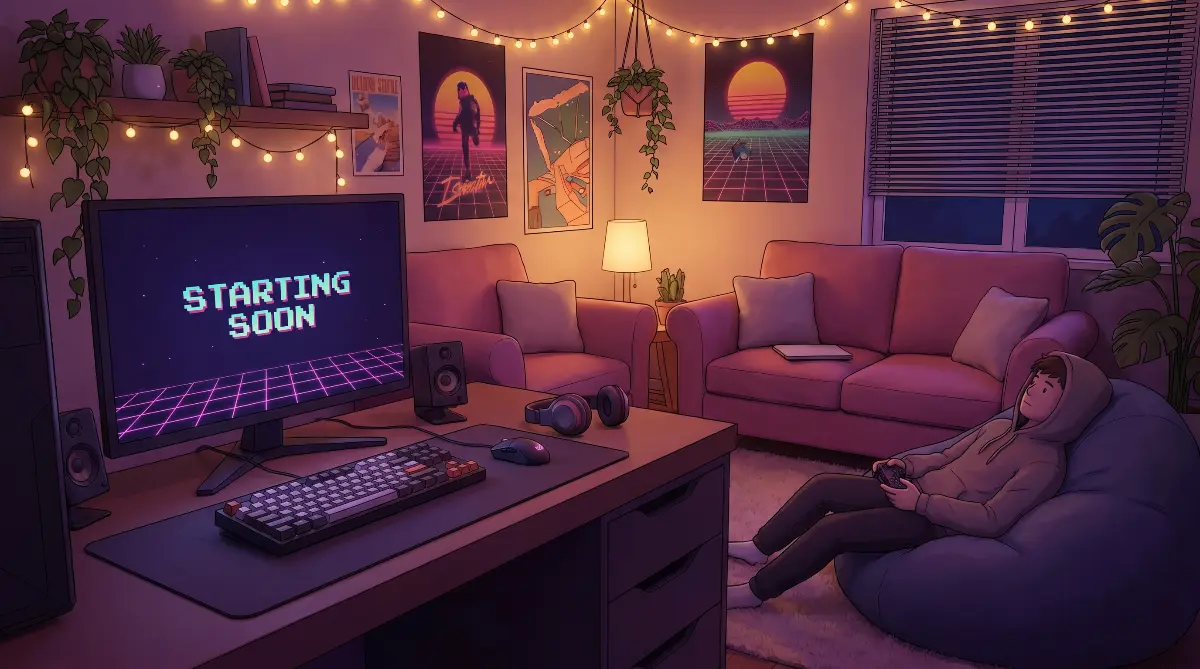
Walk through the Just Chatting category on Twitch on any given evening and you will see the same visual reappearing across hundreds of channels: a softly lit room, sunset light through a window, a record player, plants, a desk lamp, lo-fi beats playing somewhere just below the talk audio. This is the lofi aesthetic, and it has quietly become one of the most popular visual languages in streaming. It is the look that says "this stream is a place to wind down".
The market for lofi stream visuals is real and active. Etsy alone has thousands of lofi-themed Twitch overlay packs in active rotation. Behance hosts hundreds of lofi room illustrations and stream-overlay mockups. Twitch itself has a dedicated lofi tag. The demand is settled. What is less settled is the supply: almost every lofi stream pack on the market is template-based, sold to thousands of streamers, and built from a small handful of recurring visual cliches. If you are a streamer who has seen the lofi aesthetic and wants it for your channel, getting one that does not look like every other channel using it is harder than it should be.
This guide explains where the lofi stream aesthetic actually comes from, what visual elements make a scene read as "lofi" rather than just "cozy", which streamers benefit most from this look, and how to commission a custom lofi starting screen, BRB or offline scene that holds its own against the saturated template market.
- Where the lofi aesthetic actually comes from
- What makes a scene read as lofi
- Which streamers benefit most from it
- The seven core lofi visual elements
- Lofi colour palettes that work
- How lofi animation differs from other styles
- Why most lofi templates look the same
- Building a custom lofi scene that stands out
- Common lofi stream design mistakes
- The takeaway
Where the lofi aesthetic actually comes from
The lofi aesthetic in streaming is not really a streaming invention. It is borrowed almost entirely from the visual language of the lo-fi hip hop YouTube scene that exploded between 2017 and 2020, most famously the Lofi Girl channel (originally ChilledCow, rebranded as Lofi Girl on March 18, 2021 on the channel's sixth anniversary). The signature image of that channel — an animated illustration by Colombian-French illustrator Juan Pablo Machado of a girl studying at a desk by a window, headphones on, an orange tabby cat perched on the windowsill with its tail swinging, a slowly cycling day-into-night cityscape outside (it is Lyon, France — Croix-Rousse hill and the Bon-Pasteur church bell tower, not the generic Tokyo skyline most viewers assume) — became one of YouTube's longest-running and most-watched continuous livestreams. Lofi Girl now has more than 15 million YouTube subscribers and over 2.5 billion cumulative channel views; the combined "beats to relax/study to" streams crossed 800 million views by mid-2022. The character has an official name (Jade), and millions of viewers have spent hours studying, working and falling asleep to that loop.
What that channel did, almost accidentally, was define a complete visual grammar for "cozy productivity" - warm light, lived-in spaces, a single character at a small task, soft repetitive motion, a window with weather behind it, a calm interior life on a calm afternoon. Streamers picked up that grammar over the following years and adapted it for stream scenes, because the same emotional register works for talking-stream content, art streams, study-with-me streams, music streams, and slow-paced cozy gaming.
The result is that the lofi stream aesthetic has a relatively well-defined ancestry. It is not just "any cozy room". It is specifically the late-afternoon-into-evening, slightly-melancholic, productive-but-relaxed visual mood that Lofi Girl crystallised. Knowing this matters when you commission a scene, because it helps you tell the difference between a lofi scene that nails the mood and one that just has a record player in it.
What makes a scene read as lofi
A scene reads as lofi when it carries the right emotional register, not when it has the right objects. You can have a lofi room with no record player and no plants and it will still feel lofi if the lighting, colour and motion are right. You can have a room full of lofi cliches that still does not feel lofi if the lighting is wrong.
The core mood signals are:
- Warm, low-angle lighting. Late afternoon sun, golden hour bleeding into dusk, or interior lamps creating warm pools in cooler ambient. Bright midday lighting reads as not-lofi even in an otherwise correct scene.
- A sense of single, calm activity. Someone studying, sleeping, listening, drinking tea, watering a plant. Not action. Not crowds. One small focus point in an otherwise still space.
- A window with weather or time. Rain on glass, soft snow, fading evening light, a moon rising. The window is the connection to a world outside the calm interior.
- Lived-in detail. Books slightly out of place, a half-finished mug, a cat curled up, a slightly-untidy bed. The room is occupied, not staged.
- Subtle, repetitive motion. Steam from tea, a record player spinning, curtains in a breeze, lights flickering. Nothing fast. Nothing dramatic.
- Soft texture and grain. Slight film grain, paper texture, dust motes in the light. Removes the digital sterility that kills cozy.
You can build a scene with all six and skip every traditional "lofi" object (no record player, no headphones, no plant) and the scene will still feel lofi. You can build a scene with all six lofi objects and miss one of these mood signals and the scene will feel off, even to a viewer who cannot articulate why.
Which streamers benefit most from it
The lofi aesthetic does specific work for specific content types. It is a strong fit for:
- Just Chatting and podcast-style streamers who want viewers to settle in for long sessions rather than pop in for a quick highlight
- Cozy gaming streamers playing Stardew Valley, Animal Crossing: New Horizons, Coffee Talk, A Short Hike, Spirit City: Lofi Sessions, Unpacking, Cozy Grove, Spiritfarer, slow-paced indie titles (and, for the cozy-adjacent / cozy-horror lane, things like Dredge that share lofi visual conventions despite a darker undercurrent)
- Study-with-me streamers running long focus sessions where the visual environment doubles as a productivity tool for viewers
- Art and craft streamers doing illustration, knitting, painting, hand lettering, miniature work
- Music streamers playing lo-fi sets, ambient, jazz, study beats, sleep playlists
- VTubers with cozy or kawaii personas, especially in slice-of-life content lanes
- ASMR and sleep streamers where the visual mood needs to support audience relaxation
It is a weaker fit for high-energy content: competitive FPS, esports, hype-driven variety, drama-heavy commentary. Not impossible - some streamers blend lofi backgrounds with energetic content and the contrast itself becomes the brand - but in those cases the lofi look is fighting the content rather than supporting it. If you are a high-energy streamer drawn to the lofi look, you may actually want a "modern cozy" or "neo-lofi" direction rather than full lofi, which keeps the warmth without softening the content too much.
The seven core lofi visual elements
The window with a world behind it
The single most important lofi element. A window where the viewer can see weather, time of day, distant lights, drifting clouds, falling rain or snow. The window does two jobs: it gives the room scale (interior vs exterior) and it gives the scene time (the world outside is moving while the inside stays still). A lofi room with no visible window almost always feels less lofi than one with even a small window.
Warm interior light source
A desk lamp, ceiling pendant, candle, fairy lights, a glowing screen - anything that creates a warm pool of light inside the cooler ambient. Two-source lighting (warm interior + cool exterior) is the visual signature of a "cozy room as the sun sets" scene that lofi leans on heavily.
Plants
Even one plant transforms a room from sterile to lived-in. A trailing pothos, a small monstera, a few succulents on the desk. The plant does not have to be the focus - it just needs to be there. A lofi room with no plant anywhere is almost always missing something.
One personal-character object
Something that signals this is a specific person's space, not a generic room. A guitar leaning against a wall. A row of vinyl records. A camera on a shelf. A character figure on the desk. A specific game's collector's edition box. The object should match the streamer's actual interests, not be a stock prop. This is the element that makes a custom lofi scene feel different from a template.
Soft material textures
Wood grain, paper, fabric, brick, plant leaves, ceramic mug. Lofi scenes lean heavily on warm natural materials and shy away from glossy plastic and reflective glass. The texture pass is what separates a flat 3D render from one that feels cozy.
Atmospheric particles or weather
Dust motes drifting through a sunbeam. Steam from a mug. Rain on the window. Snow outside. Light smoke from incense. These small motion elements give the scene life without requiring any object to actually move. They are also disproportionately what viewers remember about a scene.
Slight imperfection
Books slightly leaning. A drawer half-open. A mug not quite on the coaster. A blanket falling off a chair. Lofi scenes feel uncanny when they are too tidy. Small intentional imperfection is what makes the room feel inhabited rather than staged.
Lofi colour palettes that work
Lofi has more colour-palette flexibility than most streamers realise. The mood is what matters, not the exact hues. Five palettes that all read as authentically lofi:
| Palette | Mood | Best for |
|---|---|---|
| Warm sunset (peach, coral, cream, soft brown) | Late afternoon, productive, optimistic | Just Chatting, study streams, cozy gaming |
| Pink retro (dusty pink, lavender, cream, gold) | Soft, nostalgic, kawaii-adjacent | VTubers, art streamers, kawaii channels |
| Blue night (navy, slate, warm lamp gold) | Late night, contemplative, calm | Late-night talk shows, music streams, ASMR |
| Forest green (sage, moss, cream, warm wood) | Earthy, slow, grounded | Cozy gaming, craft streams, nature content |
| Monochrome warm (cream, beige, brown, warm white) | Minimal, paper-textured, library | Reading streams, study sessions, podcasts |
Whichever palette direction you pick, the rule is the same: keep the contrast soft. Lofi falls apart with hard edges and high contrast. Aim for muted saturation and gentle tonal transitions. If your palette has any pure black or pure white in it, it is probably reading too sharp for lofi. Soften it.
How lofi animation differs from other styles
Lofi animation has its own grammar that distinguishes it from cinematic 3D, cyberpunk neon, sci-fi command bridges, or fantasy environments. The defining differences:
- Slower motion. Lofi camera moves are noticeably slower than cinematic 3D moves — as a rough working heuristic in our experience, around 30 to 50 percent slower. A cinematic 3D scene that does a 6-second flythrough often becomes a 12 to 15 second drift in a lofi setting. The slowness is the point; the exact ratio is editorial taste rather than a published industry standard.
- Smaller motion arcs. Lofi cameras drift rather than swoop. Often the camera barely moves at all - small parallax shifts, a gentle dolly, a subtle push-in. Big camera moves break the cozy spell.
- Repetitive ambient motion. Steam looping, a record turning, a pendulum, leaves moving. Lofi scenes are full of small motion that loops every few seconds, building a sense of continuous gentle activity.
- No dramatic lighting changes. Cinematic styles often use strong lighting reveals or dramatic contrast shifts. Lofi keeps lighting almost static, sometimes with a very slow shift over the loop (sunlight slowly dimming, lamp light slowly warming) but never sudden.
- Looser sync to music. A cinematic scene often syncs camera and motion to a beat. Lofi scenes do not sync to anything specific - they rely on the looping ambient music feeling vaguely consonant with the looping ambient visual rather than tightly coupled to it.
The same underlying file specs apply to lofi as to any other style - see our Starting Soon screen sizing guide for the technical settings. The aesthetic difference is in the motion and lighting decisions made within those specs.
Designing for vertical / Dual Format
If you are streaming with Twitch's Dual Format (rolled out from 2025 via Enhanced Broadcasting, with Aitum Vertical, Streamlabs and StreamElements as the OBS-side compositing tools), or multistreaming to TikTok Live, Kick mobile or YouTube vertical, you cannot just letterbox or crop a 16:9 lofi room into 9:16 — anything important sitting in the left or right thirds of the original composition (the window, the desk, the cat, the lamp) will be lost. A vertical lofi scene is its own composition: stack the visual elements top-to-bottom rather than left-to-right, often with the window high in the frame, the desk and lamp central, and the streamer's webcam framed at the top or bottom. Most professional lofi commissions in 2026 deliver both 16:9 and 9:16 versions as a coordinated set. If you commission custom lofi work, ask whether the scene set ships with a vertical variant by default.
Why most lofi templates look the same
The reason most lofi stream packs on Etsy and Ko-fi feel interchangeable is that they all reference the same visual ancestor (Lofi Girl) and many lean on a recurring vocabulary of stock elements: window with city beyond, desk with computer, headphones, cat by the window, plant in corner. The cozy-bedroom subgenre cycles those props especially hard, though the wider lofi corpus does branch into cafe scenes, cottagecore cottages, retro 90s gaming rooms, mascot characters and synthwave-tinted variants. The pack becomes "a lofi pack" by checking those familiar boxes, regardless of whether the result has its own identity.
This is the gap a custom lofi commission can fill. Two streamers with the same content style might both want a lofi scene, but one might be a tea-and-tarot streamer who would benefit from a witchy library scene with candles and old books, and the other might be a retro-gaming streamer who would benefit from a 90s bedroom with a CRT TV and a stack of cartridges. Both are lofi. Neither is interchangeable with the other. A template pack cannot do this differentiation. A custom commission can.
For a deeper take on the trade-off between custom and template work, see why custom 3D stream visuals outperform template packs.
Building a custom lofi scene that stands out
If you are commissioning a custom lofi scene, the elements that make it feel uniquely yours rather than a reskin of the Etsy default:
- Pick a specific time and weather. Not just "afternoon". Specifically: "Sunday afternoon in late October, soft drizzle, last warm light before evening". The specificity gives the scene its emotional fingerprint.
- Pick a specific imagined inhabitant. Not just "a streamer's room". Specifically: "the room of someone who collects vinyl, drinks too much coffee, and is halfway through writing a novel". The imagined inhabitant decides what objects belong.
- Pick one personal-character object that is yours. Your actual instrument. Your actual game collection. Your actual cat (if you have one). The thing that makes a viewer who knows you say "yeah, that's their room".
- Choose your colour palette before any 3D work starts. A lofi scene with a peach-and-cream palette feels completely different from one with a navy-and-gold palette. Lock the palette early - it constrains every other decision.
- Decide what is outside the window. A city skyline reads differently from a forest, which reads differently from a beach, which reads differently from an attic view of nearby rooftops. Pick one and commit. The window view is half the scene's identity.
- Choose one piece of repetitive motion as the "heartbeat" of the scene. Steam from a mug, a record turning, a fan slowly spinning, leaves drifting past the window. One element that is always doing something. This is what gives the loop a rhythm.
- Design the entire scene set as a coordinated package. Starting Soon, BRB, Intermission, Ending and Offline screens should share the same room, the same lighting, the same palette, and feel like four moments in the same evening rather than four separate scenes. This is the move that templates cannot match: continuity of place across an entire stream's worth of visuals.
Common lofi stream design mistakes
1. Confusing "cozy" with "lofi"
Cozy is a broader category. Lofi is a specific subset of cozy with its own visual grammar. A roaring fireplace cabin scene is cozy but not lofi. A neon synthwave bedroom is not cozy but borrows lofi conventions. Be specific about which mood you actually want.
2. Going too cluttered
Lofi rooms feel inhabited but not chaotic. Beginners often pile every lofi cliche into one scene (record player, plants, headphones, books, cat, mug, lamp, posters, fairy lights, candles, vinyl wall) and the result feels like a Pinterest mood board rather than a believable space. Pick fewer elements and place them with intention.
3. Wrong lighting time
The single fastest way to kill a lofi scene is to set the implied time-of-day wrong. A bright midday lofi room feels strange. A pure night-without-warmth lofi room feels lonely rather than cozy. The sweet spot is late afternoon into early evening, with warm interior light fighting cooler exterior light.
4. Skipping the imperfection pass
Lofi rooms designed for showroom-perfect symmetry feel uncanny. Books need to lean. Mugs need to sit slightly off the coaster. Blankets need to be half-folded. Without intentional imperfection, the scene reads as a 3D render of a room rather than a room someone lives in.
5. Over-animating
Beginners often try to animate every element in a lofi scene. The mug steams, the record spins, the curtains blow, the lamp flickers, the cat tail twitches, the rain falls, the fan rotates, fairy lights pulse, particles drift. The result is visual noise that defeats the calm-mood point. Pick two or three motion elements at most and let everything else stay still.
6. Treating it as a one-shot scene
The biggest single missed opportunity in lofi stream visuals is commissioning only a Starting Soon scene and using a generic BRB and offline screen with it. The lofi aesthetic only fully lands when every transitional moment in the stream takes place in the same world. Half-committing breaks the spell.
The takeaway
Lofi is a real and durable visual lane in streaming, with active demand and a saturated template supply. The market opening for streamers who want something better than a template is significant - most channels using lofi visuals look like dozens of others because they are using the same packs. A custom lofi scene set, designed around specific mood choices and personal character objects rather than the generic Lofi Girl checklist, can make a cozy channel feel genuinely distinctive without abandoning the aesthetic that fits the content.
If you stream cozy content and have been living with a template lofi pack you are not in love with, the upgrade path is straightforward: lock a colour palette, decide a specific imagined inhabitant for the room, pick one motion heartbeat, and commission a coordinated set of scenes that all live in the same place. Done well, the result reads as your channel's world rather than the lofi world everyone else is also using.
Lofi commissions are part of what we build at Hex Elite Studio, alongside cinematic, cyberpunk, fantasy and sci-fi directions. The aesthetic guidance in this guide applies whether you commission custom work from us, from another studio, or design it yourself. The principles are the same: mood over checklist, specificity over generic, coordinated set over one-shot scene.